REVIEW · PHOENIX
Guided 2 Hour Sunset/Night or Sunrise Hike at Piestewa Peak
Book on Viator →Operated by Scott Z · Bookable on Viator
Piestewa Peak puts Phoenix on your horizon fast. This guided 2-hour sunset/night or sunrise hike with Scott Z climbs to high ground with sweeping city views over downtown Phoenix, Phoenix Sky Harbor Airport, Tempe, and Scottsdale. Two things I especially like: the way Scott Z talks you through the Sonoran Desert (wildlife, plants, and what to notice), and the sense that you’re never just walking—you’re learning as you go. One caution: it’s a strenuous hike, so you’ll want moderate physical fitness and realistic expectations for a steep push.
The whole experience is built for timing. You’ll be out long enough to catch the “golden hour” feel for sunsets (and the darker payoff for night options), while still returning to the same starting spot so you don’t waste time figuring anything out. With a maximum of 60 people, you get the benefits of a group setting without feeling swallowed by a crowd, and the meeting point is the Piestewa Peak Trailhead at 2701 Piestewa Peak Dr.
If you’re doing the sunset/night version, the guide’s preparation makes a difference. You can expect help for after-dark conditions (including flashlights), plus support at the top like water and a snack. The main drawback is simple: the trail is demanding, and the experience depends on weather—so you’ll want to dress and pace like you mean it.
In This Review
- Key highlights to look forward to
- Why Piestewa Peak is such a strong choice for Phoenix light
- Meeting at the Piestewa Peak Trailhead (and why it matters)
- The climb itself: what you’ll do on the way up
- Sunset/night vs. sunrise: how the vibe changes with the light
- Scott Z’s guiding style: more than just pointing uphill
- Wildlife, plants, and the desert “wow factor” (without the guesswork)
- Pace, group size, and who this hike suits best
- What to bring for a Piestewa Peak sunset or sunrise hike
- Weather matters: how you should think about the plan
- Value check: is a guided 2-hour hike worth it?
- Should you book the Piestewa Peak sunrise/sunset hike?
- FAQ
- How long is the Piestewa Peak sunset/night or sunrise hike?
- Where does the hike start?
- What time does the activity run during the listed dates?
- Is this hike strenuous?
- Is the tour in English, and are service animals allowed?
- What happens if I need to cancel, or if weather is poor?
Key highlights to look forward to
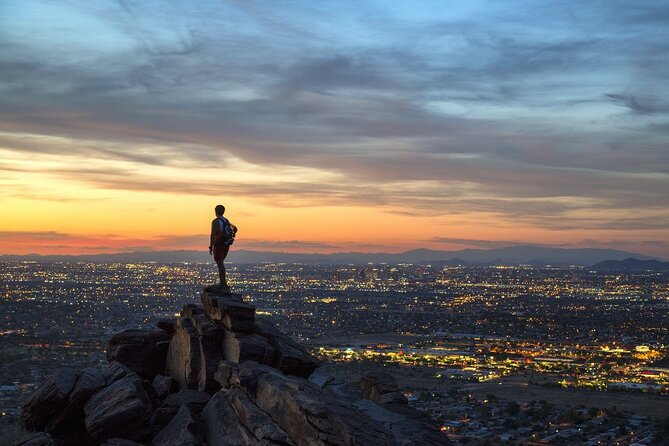
- Scott Z’s desert storytelling: he points out plants, wildlife, and small details that you’d easily miss on your own.
- Big Phoenix views in just 2 hours: downtown, Sky Harbor, Tempe, and Scottsdale all show up from high elevations.
- Sunset or sunrise timing: you’re out for the best light, not just a walk around the block.
- After-sunset readiness: flashlights and summit support help you stay steady when it gets dark.
- Small-group feel, big-group capacity: up to 60 travelers keeps it organized without being cramped.
Why Piestewa Peak is such a strong choice for Phoenix light
Piestewa Peak is one of those hikes where the payoff is built into the geography. You’re close enough to Phoenix to see the city clearly, but you’re high enough to feel the desert world take over—cool air at elevation, scrubby slopes, and a sky that changes fast. That’s exactly what makes a guided sunset/night or sunrise setup feel like better value than an unguided “let’s go hike sometime” plan.
A second reason I like this specific format is the city viewpoint. From the high elevation areas you’ll see downtown Phoenix and recognizable parts of the metro, including Phoenix Sky Harbor Airport, Tempe, and Scottsdale. That turns the hike into something more than exercise. You’re actively mapping where you are as you climb. Even if you know Phoenix well, it’s a different perspective.
Finally, the time investment is reasonable. About 2 hours means you can get the experience without committing your whole day. It also helps you avoid that common travel mistake: starting late, hiking tired, then rushing through the payoff. Here, the timing is part of the product.
You can also read our reviews of more tours and experiences in Phoenix.

Meeting at the Piestewa Peak Trailhead (and why it matters)

Your start point is the Piestewa Peak Trailhead: 2701 Piestewa Peak Dr, Phoenix, AZ 85016. For a hike like this, meeting location isn’t trivia—it affects how you feel at the start. You’re gearing up at a known place, not scrambling to coordinate rides, park, and “find the trail” as daylight fades.
The tour runs during the listed window (for the 04/25/2026–06/03/2026 dates) from 4:00 PM to 9:00 PM, Monday through Sunday. That’s a helpful frame because it tells you this is designed for evening light and/or night conditions, depending on your option. If you’re thinking sunset, it’s the right kind of schedule: enough daylight to climb comfortably, and enough time to experience the transition.
Two practical notes that help you stay relaxed:
- You’ll use a mobile ticket, so keep your phone charged.
- The meeting area is near public transportation, which can make the day easier if you’re not driving.
And remember the vibe: you’re doing a strenuous climb, so arriving early (if you can) lets you settle your gear and mindset. It’s the difference between “I’m ready” and “why did I start running late?”
The climb itself: what you’ll do on the way up
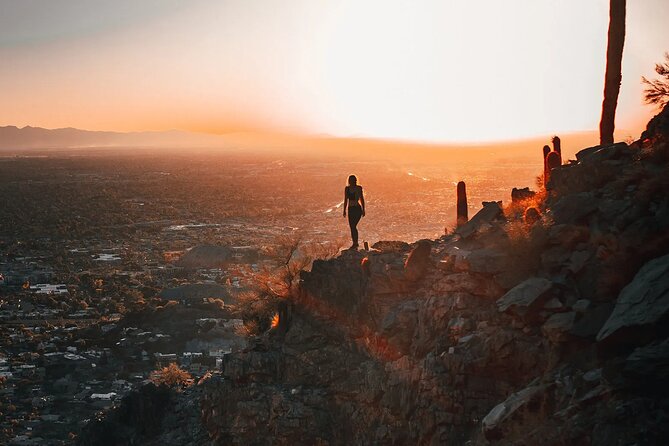
The core experience is simple: hike from the Piestewa Peak Trailhead up to higher ground where the views open up. The hike is structured as a single stop focused on reaching elevation and seeing Phoenix from above. You’ll spend about 1 hour 30 minutes on the main hike portion, and the total experience is about 2 hours.
What makes this portion rewarding is how the scenery changes as you gain height. Early on, it’s about getting your footing and settling into desert hiking rhythm. As you keep climbing, your perspective widens. That’s when you start spotting the city pieces: downtown Phoenix, the airport area, and farther out toward Tempe and Scottsdale. It’s not only pretty—it’s satisfying. You’re earning the view with effort, and you get proof fast that the climb is worth it.
Now, let’s talk about the reality of it. It’s strenuous. That means:
- You’ll want to keep a steady pace rather than sprinting your way to the top.
- You’ll likely feel the burn in legs and lungs, especially if it’s warm when you start.
- You’ll benefit from a guide who can set expectations and keep the group moving safely.
One of the strongest reasons to book this guided version is exactly that: it helps you move efficiently without turning the whole thing into a solo stress test.
Sunset/night vs. sunrise: how the vibe changes with the light
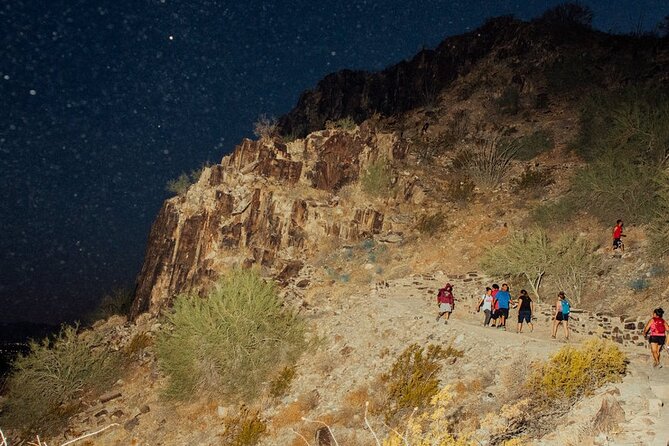
This experience is offered as a sunset/night option or a sunrise option. The light is the whole point, so the mood shifts in a very real way depending on when you go.
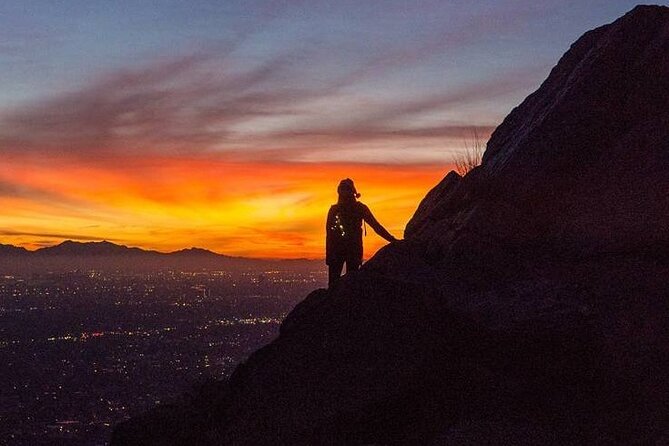
For sunset/night hiking, you can expect the “oh wow” moment when the city starts to glow as the sky darkens. That’s also when footing can feel trickier and attention matters more. This is where the guide’s after-sunset readiness helps. People mention flashlights for after sunset, and that’s exactly what you want to hear for a night-in-the-desert situation—because confidence beats guessing.
For sunrise hiking, the focus shifts slightly. You’ll spend more of the time in cooler, earlier conditions, and the payoff is the first light spreading across the city from above. The good part is that the view doesn’t just happen once; it builds as the sky brightens.
Either way, the timing is what makes the hike feel special. You’re not just hiking in the dark or waking up early for exercise—you’re doing it to catch a specific visual payoff from Piestewa Peak’s high ground.
Scott Z’s guiding style: more than just pointing uphill
Scott Z is the reason this hike feels like a guided experience instead of a leader simply walking in front. What really comes through is that he’s friendly, patient, and genuinely into sharing the desert—down to plant and wildlife details that can be hard to notice when you’re focused on your footing.
You can expect explanations tied to what you’re actually seeing. Desert hikes are full of small surprises—different cactus shapes, adaptations to heat, and signs of animals that show up only if you slow down. People also mention wildlife spotting (including a scorpion sighting). That’s a reminder that in the Sonoran Desert, you don’t just pass by nature—you move through it.
There’s also a subtle travel benefit here: Scott Z reportedly shares local happenings and broader Arizona context. It’s not a lecture. It’s the kind of added info that makes your time in Phoenix feel more grounded, like you’re learning the region’s rhythm rather than checking boxes.
And yes—this matters when the hike is strenuous. A good guide doesn’t just make the group move. He makes the effort feel organized and reasonable, with stops that let you catch your breath and look up.


Wildlife, plants, and the desert “wow factor” (without the guesswork)
The Sonoran Desert can look simple from a distance—until you learn what you’re actually looking at. On this hike, the desert talk is tied directly to the route. That’s important because it prevents the classic problem: you reach a viewpoint, snap a photo, then forget what you saw because nothing was explained.
You’ll likely notice:
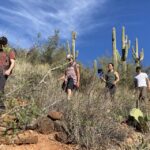
- cactus and desert plants along the route
- signs of animal life (sometimes even live sightings)
- general guidance about what’s around you and why it’s there
Even if you’re not an expert, this kind of guided attention upgrades your hike. You stop feeling like you’re just walking uphill and start feeling like you’re reading a landscape.
And if you’re lucky, you’ll catch wildlife. A scorpion sighting comes up in the experience, so don’t be surprised if the guide helps you spot something unexpected. Just keep safety in mind: if you see an animal, you don’t need to chase it or get closer—watch, learn, and move on.
Pace, group size, and who this hike suits best
This hike is capped at a maximum of 60 travelers. That number is a useful signal. It’s big enough for organized logistics, but small enough that you’re not lost in a giant wandering line.
Because it’s strenuous, the right match is:
- you want views and you’re okay working for them
- you have moderate physical fitness
- you’re comfortable hiking uphill in desert conditions
If you’re the kind of traveler who likes to arrive, walk an easy loop, then call it a day, this may not be your best fit. If you’re more in the “I want the view and I can handle the effort” camp, it’s a great match.
Solo travelers also tend to do well on guided hikes like this. You get the social structure without needing a partner to keep you moving or take photos.
What to bring for a Piestewa Peak sunset or sunrise hike
Even with a guide, you need to show up prepared. The hike is strenuous, and desert weather can change the feel of the climb quickly.
Here’s what I’d plan around:
- Water: bring enough for the climb and the time after sunset (or for sunrise conditions).
- A layer system: desert temperatures swing; even if it’s warm near the start, it can cool at elevation.
- Sturdy shoes: you want traction for uneven, desert trail footing.
- A small snack: even if the guide provides a summit snack, having your own backup can reduce stress.
- Your phone charged: you’ll have the mobile ticket on your device.
For the night option, flashlights are part of the guidance approach, but you’ll still feel smarter if you’re ready for low-light walking—slow down, keep your eyes on the trail, and let the group stay together.
Weather matters: how you should think about the plan
This is a weather-dependent experience. That means you shouldn’t lock your whole week around a single attempt unless you’ve built in flexibility.
If conditions are poor and the hike can’t run, you’ll be offered a different date or a full refund. That’s the practical part you want to know: you’re not stuck with a ruined day and no options.
My advice is to treat this like a “good chance, not a guarantee” activity. The desert is beautiful, but it’s also honest. If it’s too harsh outside, the right move is to reschedule rather than force it.
Value check: is a guided 2-hour hike worth it?
For many people, the best value isn’t the climb itself. It’s what you gain while you’re doing it. A guide turns a strenuous hike into a story you understand, with context for the plants, wildlife, and the big panoramic moment at elevation.
This one packs in a lot for a short time:
- 2 hours keeps it efficient
- high-elevation city views give you a clear reason to go
- Scott Z’s desert-focused teaching adds real substance
- the sunset/night option includes after-dark support like flashlights
If you were doing it on your own, you could absolutely hike Piestewa Peak. But you’d likely spend more time figuring out what to look for, how to pace yourself, and how to handle the after-dark portion if you go for sunset/night. Paying for a guide here is buying structure, safety, and meaning.
In travel terms: it’s a compact experience that helps you feel like you actually learned something about Phoenix and the Sonoran Desert, not just survived a steep walk.
Should you book the Piestewa Peak sunrise/sunset hike?
Book it if you want a high-impact Phoenix experience that fits into a short window. This is especially worth it if:
- you like sunrise or sunset views and want to time the climb well
- you’d rather learn from a guide than guess your way through the desert
- you’re comfortable with strenuous hiking and have moderate fitness
- you want a group setting that still feels manageable (up to 60 people)
Skip it if you’re looking for an easy walk, or if strenuous hikes make you miserable. This is a climb with a view, not a stroll.
If you’re okay putting in effort for real rewards—big city panoramas, desert spotting, and a guide like Scott Z who keeps the hike friendly and focused—this is a smart way to spend an evening (or early morning) in Phoenix.
FAQ
How long is the Piestewa Peak sunset/night or sunrise hike?
The hike runs about 2 hours.
Where does the hike start?
It starts at Piestewa Peak Trailhead, 2701 Piestewa Peak Dr, Phoenix, AZ 85016, USA.
What time does the activity run during the listed dates?
For 04/25/2026 – 06/03/2026, it runs Monday through Sunday from 4:00 PM to 9:00 PM.
Is this hike strenuous?
Yes. It’s described as strenuous, and it’s best for travelers with a moderate physical fitness level.
Is the tour in English, and are service animals allowed?
The tour is offered in English, and service animals are allowed.
What happens if I need to cancel, or if weather is poor?
The experience is non-refundable and cannot be changed. If it’s canceled due to poor weather, you’ll be offered a different date or a full refund.